Engineered Tax Services - Increase cash flow, Minimize tax payments and Increase ROI with our IRS sanctioned services including Cost Segregation Studies, Energy Tax Credits & Deductions, and Development Credits. click-to-call from the web
Engineered Tax Services provides Certified Public Accountants that specialize in Real Estate Investment Tax Strategies. R&D Tax Credits are US Government Incentives for Research and Development for new products
Tax Services Resources
To find additonal information related to Industry News regarding our services, please find the links below to websites with additional resources:
 
Cost Segregation Audit Technique Guidelines as published by the IRS
Energy Policy Act of 2005
IRS Updates on Research & Development Tax Credits
 
Featured Product - ETS creates cost segregation studies for businesses
 

ETS recently completed a cost segregation study for a large business park near Seattle, Washington.

We were able to reclassify over 28% of the real property which resulted in nearly a $2,000,000 of tax benefits.

Albert Einstein is quoted as saying: "Compounded interest is the 8th Wonder of the World. It can work for you, or against you. When you retain it, it works for you.

When you borrow it, it works against you!"


Contact Us

Engineered Tax Services. , Inc.
319 Clematis Street, Suite 603
West Palm Beach, FL 33401

Telephone: 800.236.6519
Office: 561.253.6640
Fax: 561.253.1039


What is an Insurance Appraisal?

An insurance appraisal is a replacement cost analysis which provides an accurate estimate of the amount of insurance required to replace each structure and/or amenity exactly as it stands on the day the report was prepared. The appraisal provides both a hazard and flood insurable value (if the property is in a flood zone). Engineered Tax Services, Inc. calculates each buildings reproduction cost on a component-by-component basis from the ground up. Our software processes the complex calculations needed to correctly estimate the labor and material costs for each building component and system. Our software also calculates the taxes, fees, overhead and profit to provide an accurate estimate of what it would cost to reproduce the structure today. Engineered Tax Services, Inc. may be able to take advantage of additional savings from our report as it relates to your property insurance. Our detailed engineering report can eliminate the guess work that goes into underwriting property casualty policies and believe me that guess work never works to your favor. There is also potential savings in shifting insurance rates from real estate assets to personal property assets.

Why obtain an Insurance Appraisal?

Most property owners, managers, boards and/or insurance agents believe that obtaining an insurance appraisal for their property is one of the best decisions they have ever made.
The reasons for this are simple:
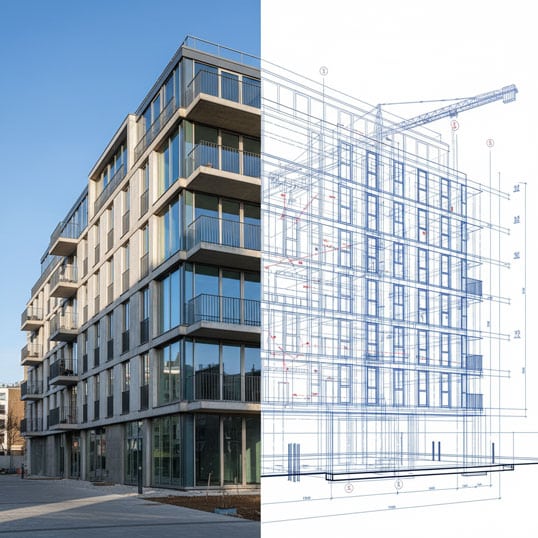
Our reports are unmatched in the industry and can serve as a cost segregation study, as well as an appraisal. A Cost Segregation Study was initiated out of a 1999 IRS memorandum allowing taxpayers to segregate various building costs into shorter depreciable lives was combined with an additional memorandum that personal property such as furniture, fixtures and equipment should be depreciated over a 5-year recovery period .

The IRS memorandum was significant to all real estate investors because the structure of a building does not only consist of the walls and roof and some interior rooms, but such other items as land improvements (storm sewers, curbs and sidewalks, parking lots, swimming pools, landscaping, etc.) and personal property (flooring, interior finishes, decorative lighting, kitchens, interior glass and electrical wiring for appliances, etc.)

While a property’s structure is subject to a 39-year recovery period, land improvements qualify for a 15-year recovery period and personal property qualifies for a 5-year recovery period. The IRS allows owners through the process of a Cost Segregation Study to identify land improvements and personal property which can be separately depreciated over the shorter recovery period such as 5 years. A building will typically yield 25%-35% of the total costs that can be segregated into land improvements and personal property. This can translate to major tax savings for savvy real estate investors.

Since depreciation is a non-cash flow item, application of this Revenue Ruling could provide a significant impact on this year's tax return. For example, a substantial tax benefit is achieved in the case where depreciation has not been taken on a building constructed for $8,000,000 with eligible improvements of $2,000,000 placed in service on January 1, 2000.  The cumulative depreciation of $1,114,200 that was previously not taken can now be deducted in the first year of change.  Additionally, the balance of the depreciable assets continues to be depreciated over the remaining life.  With the depreciation deductions over the remaining useful life provide an after tax present value benefit of $600,000.

• Obtaining an insurance appraisal demonstrated due diligence on the part of the board members, property manager and/or insurance agent.
• The owners, board members, manager and/or agent have the peace of mind knowing that the property is accurately insured.
• An insurance appraisal assists your agent in placing the property coverage with a carrier by providing documentation that underwriters need to write coverage.
• Obtaining an insurance appraisal prevents under-insuring, which puts the property at risk for having funds to rebuild in the event of a catastrophic loss, or over-insuring, which results in paying extra insurance premiums.
•  An insurance appraisal provides a third party, unbiased valuation of the property’s replacement cost.
• If a loss occurs, a ETS appraisal, along with all data acquired in performing the appraisal, will be available to the client to help expedite the settlement of the claim.
• All digital photographs taken at the time of the physical inspection are electronically achieved for the clients use in the event of a loss.
•  Having an up-to-date insurance appraisal provides accurate values for coverage, eliminating the possibility of a co-insurance penalty in the event of a loss.
What is Involved in an ETS Insurance Appraisal?
• A full consultation with a representative of the property to discuss the scope of the work.
• In-depth on-site inspection of the property by the appraiser.
•  Examination of all construction plans for the structures included in the insurance appraisal.
• Production of appraisal report with the construction plans utilizing state of the art engineering and construction cost data software programs.


The complete insurance appraisal includes:

• Definition of Hazard Valuation (Any non-flood peril)
• Definition of Flood Valuation (based on National Flood Insurance Program Guidelines)
• Detailed Building Descriptions
• Property Location Map
• Photographs of Each Appraised Structure (High Resolution Digital Photographs)
• Recapitulation of Values
• Replacement Cost Estimates (Hazard and Flood)
• Insurable Replacement Cost Estimates (Hazard and Flood)
• Depreciated Replacement Cost Estimates (Hazard and Flood)
All digital photographs taken at the time of the physical inspection are electronically archived for the clients use in the event of a loss.

Who needs an Insurance Appraisal?

Condominiums
Home Owner Associations
Master Associations
Co-ops
Time Shares
Country Clubs
Golf and Tennis Clubs
Hotels and Resorts
Medical Buildings
Marinas
Retail Stores
RV Resorts
Bed and Breakfast Inns
Hospitals
Commercial Buildings
Office Buildings
Colleges and Universities
Libraries
Municipalities
Theaters
Museums
Strip Malls
Warehouses
Zoos
Retirement Homes
Banks
Service Stations
Restaurants
Private Schools
Public Schools
Sports Stadiums
Car Dealerships
Conservatories
Funeral Homes
Residential Properties
Private Estates
Yacht Clubs